Carlo Chatrian announces debut festival of 'contradictions'
by Richard Mowe
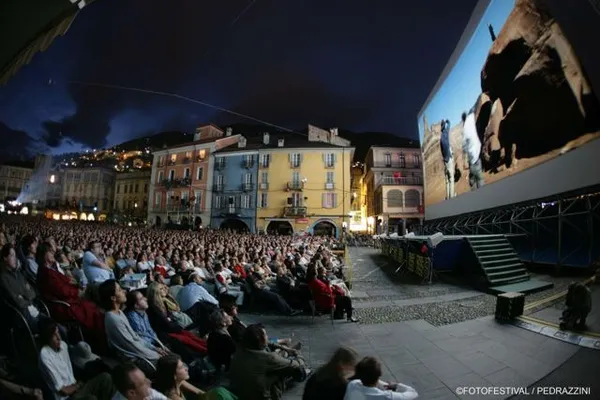
The 8,000 seat Piazza Grande Photo: Fotofestival/Pedrazzini
The new director of the Locarno Film Festival, Carlo Chatrian (who has succeeded Olivier Père), today revealed its complete selection for the 66th edition running from August 7 to 17.
Chatrian, launching the programme at a media gathering in Berne, said the aim was to stimulate a dialogue between contemporary film and classics, independent cinema and more commercial fare, between documentaries and fiction as well as experimental film-making. “The dialogue may well throw up contradictions – and so much the better,” he said.
His plans embrace a 20-film competition line-up almost entirely comprising world premieres, and a Piazza Grande programme that combines blockbusters with cinema d’auteur and classics.
The 8000-seat Piazza Grande, the largest screen in Europe and the festival’s iconic venue on the picturesque town’s main square, will include Quentin Dupieux’s crime comedy Wrong Cops, featuring Goth icon Marilyn Manson; Mr Morgan’s Last Love, a drama from Sandra Nettelbeck that stars Michael Caine as a retired professor who finds a connection with a young Parisian woman; We’re The Millers, a comedy from Rawson Marshall Thurber with a cast that includes Jennifer Aniston and Ed Helms and Richard Curtis’s time travel comedy About Time with Domhnall Gleeson, Rachel McAdams and Bill Nighy.
Also scheduled in this venue, is the 1981 classic Rich And Famous, part of the festival’s retrospective dedicated to director George Cukor and which the film's star, Jacqueline Bisset, will be in Locarno to introduce. In addition, there will be Werner Herzog’s Fitzcarraldo, the director’s 1982 biopic about Brian Sweeney Fitzgerald. It will screen as part of the festival’s homage to Herzog, who will be honoured with a lifetime achievement prize.
The Piazza Grande will also feature an Italian film - La Variabile Umana (The Human Factor), the feature debut from acclaimed documentarian Bruno Oliviero.
As has been previously announced 2 Guns, from Baltasar Kormákur starring Denzel Washington and Mark Wahlberg will open the festival on August 7. Kormákur, Icelandic filmmaker, whose first film 101 Reykjavik was in competition at Locarno in 2000, returns to introduce his American action comedy
Britain makes a showing in the Competition section courtesy of Joanna Hogg, whose latest, Exhibition, stars Viv Albertine, formerly of punk band The Splits. Among the other Competition highlights are: E Agora? Lembra-me (What Now? Remind Me) from Portugal’s Joaquim Pinto, the director’s touching and vibrant telling of his battle with HIV; Albert Serra's Historia De La Meva Mort (Story of My Death); Real, the first film in five years from Japan’s Kiyoshi Kurosawa; U Ri Sunhi (Our Sunhi) by South Korea's acclaimed Hong Sang-soo; and Sangue (Blood) from Italy’s Pippo Delbono, which explores Italy’s Red Brigade insurgency.
Short Term 12, an expansion of a 2008 short (both directed by Destin Cretton), is the only US film screening in Competition.
The festival will also screen recent films from the members of its various juries, among them Norte, Hangganan Kasaysayan (Norte, The End Of History) from jury president Philippine director Lav Diaz, Sebastián Lelio’s Gloria, which will screen in the Piazza Grande, was produced by jury member Juan de Dios Larraín; while Que d’Amour, directed by and starring France’s Valérie Donzelli (she also appears in Lionel Baier's Les Grandes Ondes (Longwave), scheduled to screen in the Piazza Grande) and Alpis, directed and produced by Greece’s Yorgos Lanthimos, will show the talents of two other members of the main jury (the fifth jury member is Swiss cinema expert Matthias Brunner).
Nine other films directed or produced by members of sidebar juries will also be shown. The Festival ends with the Awards ceremony on Saturday, August 17, followed by the closing film, Pascal Plisson’s On The Way To School, a French documentary screening as an international premiere. The film will be introduced by its director, and follows four children in different parts of the world – the savannahs of Kenya, the trails of the Atlas mountains in Morocco, Southern India or the plateaux of Patagonia – struggling to acquire an education.

 Facebook
 Reddit