Sean Pecknold on bringing a neighbourhood to life in Tennis, Oranges
by Jennie Kermode
Tennis, Oranges
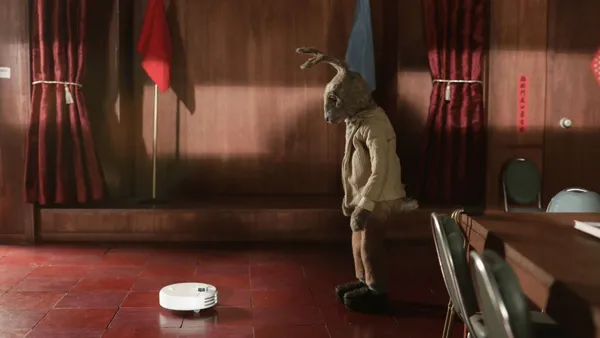
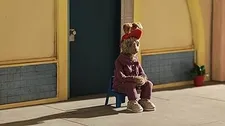
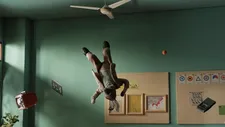
When all the humans have gone away due to Covid lockdowns, a lonely hospital cleaning robot, left with nothing to do, begins to question its purpose in life. It’s a journey that will lead it to befriend an elderly rabbit who makes his living on the streets of Los Angeles’ Chinatown, in this often comedic but surprisingly poignant short animation by Sean Pecknold. A few months ago io met Sea at an animation event where he talked about the film and how he developed its distinctive characters.
Tennis, Oranges
“The project began as a seed for a story in 2014, a long time ago,” Sean begins. “When I first moved to Los Angeles, I didn't have any friends, I didn't have any work, I didn't have any money. I was struggling to find my place. But on Craigslist, I found a workspace on really quiet street in Chinatown called Chungking Road. If you haven't been, I highly recommend going. It's a very quiet, pedestrian-only street in old Chinatown that's very colourful and graphic and beautiful and calm, which is very unlike the rest of LA, that's very chaotic and car centric.
“Me and my wife [Adi Goodrich], who is a production designer on Tennis, Oranges, ended up renting an old art gallery on that street, and we worked there on animation and film and design projects for about four and a half years. Because we spent ten hours a day there, we got to know the street really, really well, and the friends in the neighbourhood who either lived there or worked there. And that just kind of seeped into our subconscious. When we moved out, we were like, ‘Let's make a ten minute animated, stop motion short film about that street.’
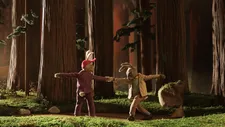
“We had met two people in particular that inspired our characters that in the film are rabbits, but in real life are humans. They were in their nineties. They passed away around the same time we started making the short, about 2019, early 2020. And so the script was written, storyboards were drawn. I made one tweak to the story. Originally the main character was another rabid puppet, but it's very hard to animate puppets, as stop motion animators know. We had to simplify it. We didn't have any funding for our short. It was all self initiated, self produced, self funded. So we simplified to this vacuum as the main character. But I like simple restrictions in storytelling like that. It made me focus on how to tell a story with a simple plastic object and try and make you care about that.
Tennis, Oranges
“The production started going full bore in about 2020, when the whole world shut down in March. We were like, ‘What else are we going to do? We have no clients, there's no work anymore. Let's start making this film.’ And so we started building sets and making puppets. It was an opportunity for me to connect with other animators in Los Angeles, because I'd been developing the feature and I was like, ‘I don't quite have stop motion in 3D in real sets with puppets figured out.’ I've done a lot of multi plane animation and live action as well. So it was a great opportunity to bring in animators from, you know, Pinocchio or TV shows in LA at the time. It was so wonderful.
“During the pandemic, animation was booming, so it was actually hard to get animators. Stop motion was having a big moment. But we would just keep plugging away at our short. For three years we worked on a few minutes here, a few minutes there. We’d raise a little bit of money from a commercial project and bring another animator back in for three or four weeks. It was a very hard thing to maintain the energy, enthusiasm and motivation to actually see it through, and that was one of the most illuminating things for me in the whole process.
“You have to find ways to stay motivated. Because often, at least in the States – I know Europe is a different ecosystem for animated shorts, there's grants and funding and producers and there's this buzz of activity – in the States, it's like crickets. There are shorts made, but it's often student shorts or maybe a big high profile Disney short or something. So we were like the scrappy, weirdo independent animated short happening in town. I think people would come into our project and be like, ‘What is this? What is Tennis, Oranges?' And they still say that. They're like, ‘What is this?’” He laughs.
Tennis, Oranges
I point out that there has been research showing that most people with cleaning robots name and gender them. Was that a starting point for him?
“I think people can become attached to these helping robots now, and see personality in them, even thought they lack a face,” he says. “They do have a voice! Recently a vacuum cleaner escaped a garage after an earthquake in California, and escaped down the street, and people took videos of it.”
How did he decide which objects would respond to the robot and which would not?
“I wanted the vacuum character to mostly have conversations mostly with other inanimate objects: his co-workers, the other chairs in the hospital and the garbage can. Though he wanted to have connection and purpose with more animated characters. In my mind the rabbit characters could not communicate with him. I like stories that are mostly wordless, so this fit that way of filmmaking.”

 Facebook
 Reddit