Abderrahmane Sissako on night shoots and Black Tea
by Casper Borges
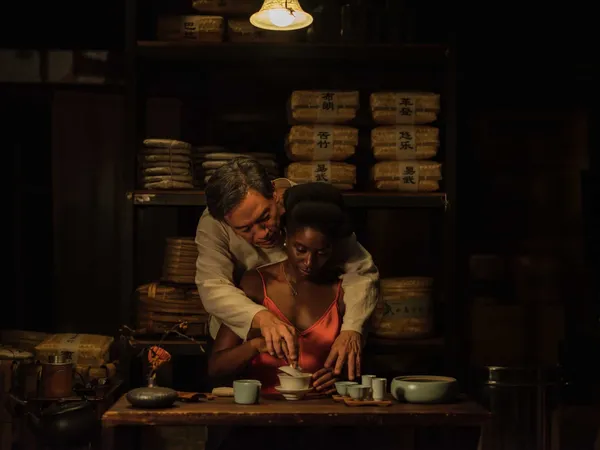
Black Tea Photo: Cinêfrance Studios Archipel 35 Dune Vision
Mauritanian director Abderrahmane Sissako's Black Tea follows the story of Aya (Nina Melo), who leaves the Ivory Coast in search of a new beginning in Guangzhou, China. She is hired by Cai (Han Chang), who runs a tea boutique; he sets about teaching her all he knows, and over time they discover a tender love for one another.
Black Tea was nominated for the Golden Bear award at the 2025 Berlin Film Festival. Sissako previously directed the 2014 drama, Timbuktu, about a family living in the sand dunes on the fringes of the city of Timbuktu, who have evaded the attention of the Jihadists, until now. 2002's Waiting For Happiness (Heremakono) follows two characters meeting in the Mauritanian city of Nouhadhibou, while 2006's Bamako explored the tensions between a married couple against the backdrop of broader political and economic issues.
Speaking with Eye For Film, Sissako discussed the decision to set Black Tea predominantly at night, systems of violence and the political tones of his cinema. The following has been edited for clarity.
Casper Borges: What motivates you to use the cinematic medium to tell stories?
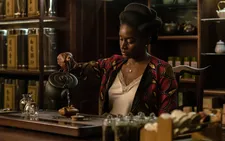
Black Tea Photo: Cinêfrance Studios Archipel 35 Dune Vision
Abderrahmane Sissako: As a filmmaker, I like pushing to freely use the cinematic medium because I do a movie every two years, and I want to give the movie the time it needs. So, I push my vision forward to talk about something that's not necessarily special, but it's something only I can do because it's either what I know or it's important to me. This is especially true when we talk about Black Tea because it's about immigration, about an African woman in China. Not a lot of people know about this and there aren't many artists that can make movies about this subject.
So, my job as a filmmaker, or even an artist, is to try and do something that's a little bit special. But my final thought is that my role as a filmmaker is to create hope and to believe in something different.
In Black Tea, Li-Ben is a young guy who can show us that China can be different because he doesn't have the same vision as his grandparents. And it's very important to say that China will be different in the future. It's my job as a filmmaker to do this, and it's also important to take the audience somewhere different.
CB: When you say the story comes from something you specifically know, was this the case with Black Tea?
AS: More than 20 years ago now, I saw Chinese people beginning to come to Africa to live, and to open shops and small businesses, like it is in Chinatown in New York. And in my 2002 movie, Waiting For Happiness, there's a dinner scene between a Chinese man and an African girl.
CB: One of the striking things about Black Tea is that the majority of the scenes are shot at night. What was the creative thought process behind this decision?
AS: One of the most important decisions I made was to shoot the movie in Taiwan because China wouldn't be accepting of this type of script. So, I moved to another location, and I decided to make the movie at night to create something different, and something smaller in scale. This was partly influenced by the fact that China is very big compared to Taiwan.
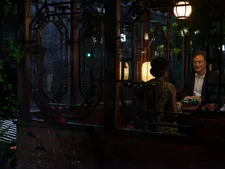
Black Tea Photo: Cinêfrance Studios Archipel 35 Dune Vision
The cinematic medium will provide you with many solutions to problems, and in this case, night would create some intimacy for the story. There are only a handful of scenes that are not shot at night, and it was important to me to not allow myself to be restricted and only shoot at night.
CB: Picking up on your point about Chinese sensitivity towards the film's script, a necessary question, given the subject of migration, is how Black Tea relates to or fits into our present day?
AS: This question is really difficult. Today, the world we live in is a special but also a terrible place for many reasons. To me, the terrible thing is when power is used in the wrong way, and, of course, globalisation has changed things. When Chinese students go to the US to study at Harvard or MIT, they then go back home and use what they have learned in a positive way. And China has never come to Africa and started wars - that's the western system, of Europe and the US. It's about systems of violence, and we have to be careful about creating a new fascism.
CB: Do you see yourself as a political filmmaker?
AS: I am a kind of political filmmaker, yes, but it's not really my mission. Cinema is to share something, to give the audience the opportunity to maybe understand something in more detail. The mission of a filmmaker is to facilitate this, and I cannot make movies without being political, and I wouldn't use my time to make something another person can do. So, I want to be political, but the political never goes against the beauty of the film. It has to be a part of its beauty, to be a part of its hope.
Black Tea opened theatrically In New York and Los Angeles on May 9th.

 Facebook
 Reddit