Hugo Ruíz on storytelling techniques, kinky cinema and Dante
by Paul Risker
Dante
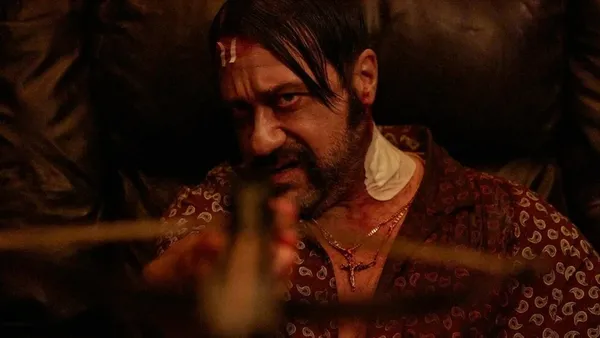
Spanish director Hugo Ruíz’s sophomore feature, Dante, takes place over the course of a single night in Madrid. When paramedic and all-round good guy Eduardo (Chino Darin) responds to an emergency call, he finds Mario (Enrique Arce), a local crime boss, bleeding out. Soon, Mario’s partners in crime, Santo (Vicente Romero) and Mak (Ester Expósito) are at the door of the apartment, wanting payback for his betrayal. But first, Mario has something of value. Eduardo is held at gunpoint with instructions to keep Mario alive. Gradually the night spins out of control, dragging Eduardo into a violent and bloody nightmare.
Dante is the second in Ruíz’s planned trilogy of films set over a single night in the Spanish capital. The first in the trilogy, One Night In Adela, followed a street cleaner on a revenge-fuelled rampage. Ruíz’s has also directed the short films, Taxi Fuera De Servico and ¿Estás Ahí?
Speaking with Eye For Film, Ruíz discussed his obsessive approach to storytelling, the challenges of a shift in tone part way through Dante, and combining American and Spanish influences.
Paul Risker: What films inspired you when you were younger and cemented your love for cinema?
Hugo Ruíz: Due to my age, I was pretty much inspired by American Cinema in the Eighties: The Goonies and Back To The Future, as well as Jaws. Watching films in the theatre, I’d imagine how I could do something similar to that. So, I remember going with my friends and coming out of the film, and I had watched two films, and they had only watched one. I was concerned with how the filmmakers had made the film, including such things as the placement of the camera. My friends would look at me awkwardly, and they’d be like, "What are you talking about?” So, since I was eight or nine years old, I had this dichotomy inside of me where I was watching movies from two points of view.
PR: There’s often a sadness when you reach the end of a film, and so, I wonder if putting off the ending is an added benefit of this trilogy you’re undertaking.
HR: I don't know why, but the number three speaks to me. I draw, and when I create these small drawings, I’ll always draw three. It's probably easier for me not to say goodbye to that film, but it is funny because the next movie I'm going to shoot is not going to be the final film in the trilogy — it will be something totally different.
It's funny that I have made that decision, because, generally speaking, I have this obsessive need for things to be finished and to have an ending.
PR: In the production notes, I read that the intention was for this film to be crazy. How did you deal with the challenges of raising the stakes scene after scene?
HR: One of the main challenges in that regard is the scene in which they go to the house of this old woman to take care of her wounds. And it was risky because the rhythm radically drops. But it was an important scene for me because I wanted to see this part of Eduardo’s job, and it was also an important moment in his and Mak’s relationship — the two main characters. So, that break/pause in the middle of the action was the main challenge. But the film by itself, and this was intentional, pushes you forward as the tension increases.
PR: Beyond the film’s desire to entertain its audience, what were the thematic or broader motivations?
HR: In my first film, I was clear that I wanted to have a critical discourse about the bad things the church had done to children. With Dante, I wanted people to be immersed in the film, to be part of it, and to have a great time. But something that amazes me about human beings is their contradictions, and I show that duality in this film in a very harsh and striking way. Everybody can identify with that duality that’s inside of us.
PR: With Pulp Fiction and After Hours being sources of inspiration for Dante, how do you see the way Spanish and American cinema have interacted to shape the film?
HR: You're right that After Hours was one of the inspirations, and of course, I adore Tarantino. But here in Spain, during the Seventies and Eighties, there were a variety of directors doing something called 'kinky cinema'. The word kinky referred to delinquents or small-time criminals. If you haven't watched that kind of cinema, I encourage you to. For example, there is one called Street Dogs (Perros Callejeros). And one of the filmmakers of this type of cinema was Eloy de la Iglesia, who was one of the directors I had in mind when creating Dante.
So, I took the soul of these kinds of characters from that culture, and I combined them with this American influence. And when I'm asked about the film, I would start by saying that the soul is a kinky film with Tarantino-esque influences.
With After Hours, it was more about the rhythm of the storytelling. As you know, Tarantino wouldn't tell a story that takes place over just one night. Apart from Reservoir Dogs, the story would take the whole day. But I wanted to keep After Hours in mind.

 Facebook
 Reddit