France’s film industry mourns death of Jean-Paul Rappeneau at 94
by Richard Mowe
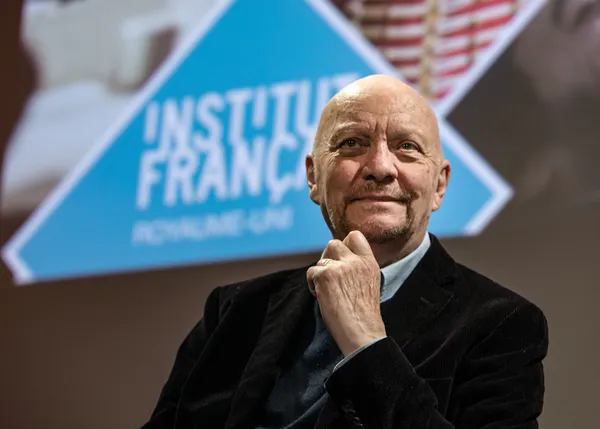
Jean-Paul Rappeneau in 2018 at the French Film Festival UK Photo: Richard Mowe
Famed and universally fêted French director and screenwriter Jean-Paul Rappeneau, who was known internationally for his 1990 Oscar-nominated drama Cyrano de Bergerac with Gérard Depardieu in the title role, has died at the age of 94. His family made the announcement today.
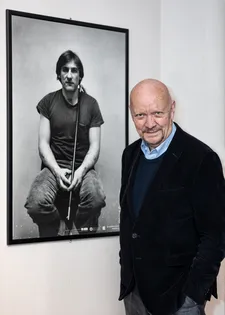
Jean-Paul Rappeneau beside an image of a youthful Gérard Depardieu when he visited the French Film Festival UK in 2018 Photo: Courtesy of the French Film Festival UK
The adaptation of the play written in poetic alexandrines by Edmond Rostand, became one of the biggest hits in French cinema history for the quiet-spoken Rappeneau, who was born in the town of Auxerre in central France. His career covered more than 50 years of French film history. He was a self-confessed perfectionist and later in his career had difficulty finding finance for his projects. His last work Families emerged after a period of introspection and starred Mathieu Amalric as a Shanghai-based French financier who returns home to find the family mansion is being sold off.
Rappeneau was persuaded to return to work by the idea of a film which enabled him to revisit to his roots in Auxerre in Burgundy, where he lived with his parents for the first 18 years of his life before moving to Paris to continue his studies and eventually move in to the film world.
He worked his way up as screenwriter with credits which included Louis Malle’s Zazie In The Metro (1960) and A Very Private Affair (1962) as well as Philippe de Broca’s classic thriller That Man From Rio starring Jean-Paul Belmondo. His introduction to feature film directing came in 1966 with A Matter of Resistance (La vie de chateau), a romantic comedy set on the eve of France’s World War Two liberation starring Catherine Deneuve. They worked together again on his 1975 film Le Sauvage, co-starring Yves Montand as a man living a solitary on a Caribbean island who becomes entangled with a runaway bride. Other directorial credits include All Fired Up (1982)
Watching Citizen Kane as an impressionable young man provided the impetus. Familles was his eighth feature in a career that had been characterised by an emphasis on quality rather than quantity – from his major international success with Cyrano, for which Gérard Depardieu won the prize for best actor at the Cannes Film Festival as well as The Horseman On The Roof with Juliette Binoche and Bon Voyage with Isabelle Adjani.
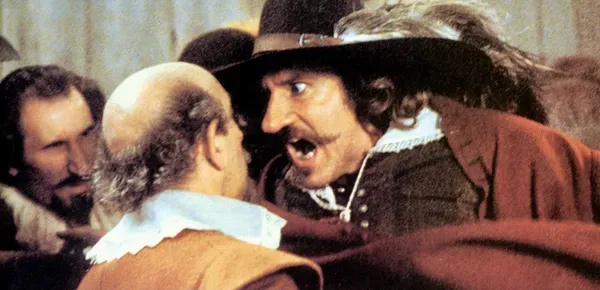
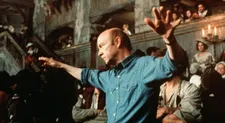
Gérard Depardieu in Cyrano De Bergerac, directed by Rappeneau, who said: I almost refused on the spot, but I read it again, and then remembered it was the first play I’d seen with my mother and my sister. I was about eight years old and it blew me away.' Photo: UniFranceJean-Paul Rappeneau directing Cyrano de Bergerac Photo: UniFrance
Cyrano, however, remains his most garlanded work with five Oscar nominations (best actor, screenplay, foreign film, set and costume with a victory in the latter) as well as a Golden Globe for best foreign film, six Baftas, and ten Césars.
He once told me: “I would never have dreamed of adapting a theatre play written in the 19th century which seemed, when it was first mentioned to me, like a dusty old-fashioned thing. I’d already made many films and one day, the rights for Edmond Rostand’s play became public. I was asked to adapt it. I almost refused on the spot, but I read it again, and then remembered it was the first play I’d seen with my mother and my sister.
Jean-Paul Rappeneau with Richard Mowe on a visit to the French Film Festival in 2007 Photo: Lloyd Smith
“I was about eight years old and it blew me away. When I rediscovered the play, those old emotions came to the surface again and I took it on. True to my childhood emotions, I took great pleasure in making the piece my own once again. I’d never have imagined doing something like that. ”
The play lasts three hours 20 minutes and the film two hours 25 minutes. “We had to cut some lines, which were often impossible to cut because of the rhyming scheme. Jean-Claude Carrière, the great screenplay writer, dramatist, and author wrote scenes ‘in the style of’ Rostand to shorten them. He’s a wizard with words.”
Acclaimed British novelist Anthony Burgess was hired to do the subtitles. Rappeneau confides that Depardieu was unfamiliar with the play. “But he recognised himself in this story of a man who was at once very strong, capable of fighting a hundred people, and very weak, crippled by a secret wound that stops him loving anyone. It’s the story of a man who does himself harm, who doesn’t love himself. And I found that very moving because there are so many people like that. That’s Cyrano for you, more or less. Immense qualities, but hidden.”

 Facebook
 Reddit