Dardennes, Banderas and Sciamma among other winners
by Richard Mowe
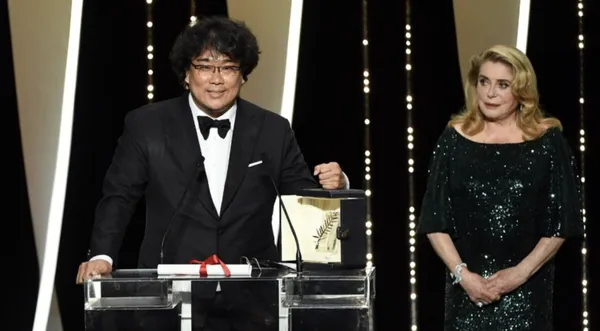
Winner Bong Joon-ho receives his Palme d’Or from Catherine Deneuve Photo: Festival de Cannes
South Korean director Bong Joon-ho’s Parasite has won the Palme d’Or at this year’s 72nd Cannes Film Festival for a narrative that explores class warfare in South Korea, pitting a poor clan of grifters against an obscenely wealthy family. He was presented with the award by Catherine Deneuve.
Mati Diop earned the Grand Prix for her début feature Atlantique, which examines the refugee crisis through a woman separated from her love. She made Cannes history as the first black female director in the Competition.
The much favoured Pedro Almodóvar was left out of the accolades although his lead player Antonio Banderas won Best Actor for the semi-autobiographical Pain And Glory. Banderas said: “People think we live in a red carpet, but it’s not true. We suffer a lot, we sacrifice, and there is a lot of pain behind an actor of any kind. But there is also glory, and this is my night of glory.” He dedicated his award to Almodóvar.
The Best Director award went to Belgium’s Jean-Pierre and Luc Dardenne for Young Ahmed.
There was a tie for jury prize to a pair of politically charged features, first time French director Ladj Ly’s Les Misérables and Brazilian director Kleber Mendonça Filho and Juliano Dornelles' Nighthawk/Bacurau. Radical film-maker Michael Moore presented the awards and told the audience “Trump is the lie that enables more lying.”
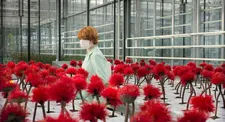
Best Actress was awarded to Emily Beecham for her role in Little Joe as a scientist who begins to suspect that the plant she has genetically modified may have adverse side effects.
French writer-director Céline Sciamma earned the screenplay award for Portrait Of A Lady On Fire, a lesbian-themed period film in the vogue of The Favourite that explores the notion of the female gaze, both now and throughout the tradition of Western art.
Little Joe Photo: Courtesy of Cannes Film Festival
Israeli film-maker Elia Suleiman’s It Must Be Heaven earned a special mention from the jury for his comedic commentary on his country’s troubles.
The international critics (Fipresci) presided over by journalist Paulo Portugal also rewarded Suleiman's film with the Fipresci prize in the Competition. Beanpole by Kantemir Balagov was the critics' top prize in Un Certain Regard while Robert Eggers’ The Lighthouse was rewarded in the Directors’ Fortnight.
Despite being in the red carpet throng, Quentin Tarantino went away empty-handed for his opus Once Upon A Time In Hollywood although the Palm Dog gong for his canine star Brandy may be some consolation.
Jury president Alejandro González Iñárritu cohorts comprised French author-artist-director Enki Bilal, French director Robin Campillo, Senegalese actress-director Maimouna N’Diaye, American actress Elle Fanning, Greek director Yorgos Lanthimos, Polish director Paweł Pawlikowski, American director Kelly Reichardt, and Italian director Alice Rohrwacher.
Competition winners:-
Palme d’Or: Parasite by South Korean director Bong Joon-ho


 Facebook
 Reddit