





Eye For Film >> Movies >> Elsinore (2026) Film Review



In September 1989, Daniel Day-Lewis was on stage playing Hamlet at the National Theatre, London, and then he was not. Shocking the audience that evening, the actor, during a scene in which Hamlet is confronted by the ghost of his father, walked off-stage. He collapsed backstage and has never walked the boards of the stage again. What happened that evening has become one of theatre’s great anecdotes, fuelled by Day-Lewis’ own response that suggested he saw the ghost of his own father. More than 10 years later, in an interview, he told The Guardian: “I had to leave the stage because I was an empty vessel. I had nothing in me, nothing to say, nothing to give.”
Simon Stone’s Elsinore, written by Stephen Beresford, begins that September evening and goes on to tell the story about the casting of Scottish actor Ian Charleson (Andrew Scott), whose interpretation of the Danish prince received a rapturous critical reception.
Elsinore is a story in which Charleson’s onstage triumph was overshadowed by the reality that, at age 40, he was dying from AIDS. Stone and Beresford weave together the fevered behind-the-scenes staging of the production with Charleson’s personal struggle, which only a select few were privy to.
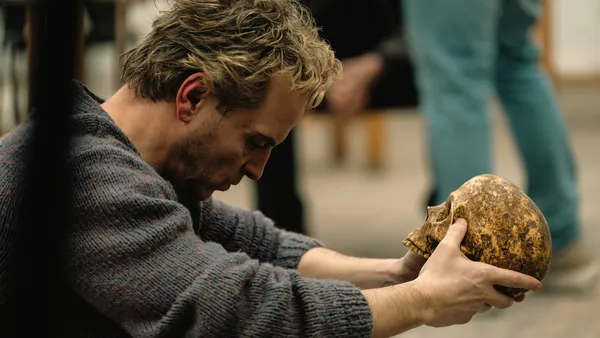
The retelling of the 1989 production and Charleson’s incarnation of one of Shakespere’s most recognisable characters, gives credence to Day-Lewis feeling the need to leave the stage. There’s a ferociousness to the way Scott plays Hamlet that swallows up the screen and, dare I say it, our gaze. It’s no longer as though we are sitting in a cinema with a performer reaching across the screen. Instead, it’s a transportive experience. One would be forgiven for thinking you can breathe in the smell of the stage, feel the actor’s close proximity, and even feel the violent turmoil in Hamlet’s tormented soul. And in these moments, cinematographer Mike Eley precisely judges distance – never too close nor far away, observing from a distance while entering the space of the live performance within the film. Meanwhile, editor Valerio Bonelli cuts just enough not to trip up the beat.
Stone and Beresford bring to life the backstage milieu, shaping Elsinore into an observation, if not a celebration of the creation of family through creative gestation. While his terminal illness was not revealed until after his death, deep into the epidemic, many would have suspected Charleson's symptoms were AIDS-related. It lends an interesting dimension to the drama to consider what the different interactions between he and his colleagues communicated.
Some of the most captivating exchanges in the film are between Charleson and artist and filmmaker Derek Jarman (David Dawson), who was openly gay and disclosed his diagnosis. He urged Charleson, who he had directed in the film Jubilee, to do the same. These scenes, especially the one outside Jarman’s cottage, capture the tragedy of these souls, but they also emphasise how politicised these men were because of their sexuality and the disease. Charleson wanted to transcend this politicisation, to not be defined by his homosexuality or to be labelled a victim. These opposing ideological differences created a friction between the two peers, which Stone and Beresford perhaps too sparingly explore.
In some of these scenes, the depth of Scott’s performance is revealed, filled with a restraint and subtlety, where he expresses himself non-verbally. At times, his whole poise and silent thoughts create a rich character.
In a long-held tradition at the National Theatre, on opening and closing nights, as well as press nights, the actors bang on their windows for the beginners call. The dressing rooms overlook an internal quad, filling the space with a thunderous sound as they express their camaraderie. Imagining this thundering sound ringing out as Charleson will have made his way to the stage, is channelled by Scott in the scorching energy of his performance. It’s therefore ironic and achingly disappointing that a film about unflinching resilience fades with a whimper. It’s as if Scott’s performance of Hamlet is trapped in a nightmarish realm, and is trying to appeal to God with the thunder of his physicality and the crackling lightning bolts of his words.
Scott’s beacon of light is swallowed up by Stone and Beresford’s heavy-handedness. They are insistent on holding the audience’s hand to tell them how they should feel when the film reaches its emotional crescendo. Unlike Chloé Zhao’s Hamnet, when the director surrenders the film to the audience, Stone and Beresford are unwilling to do the same. Instead, they refuse to let go of a work they clearly care for, and in so doing deprive it of the emotional freedom it so desperately wants and needs. And yet, in large part thanks to Scott’s majestic performance, the raw emotions of this truthful story punch through the painting by numbers filmmaking to move us enough to at least moisten our eyes.
Reviewed on: 28 Oct 2026