



 Facebook
 Reddit
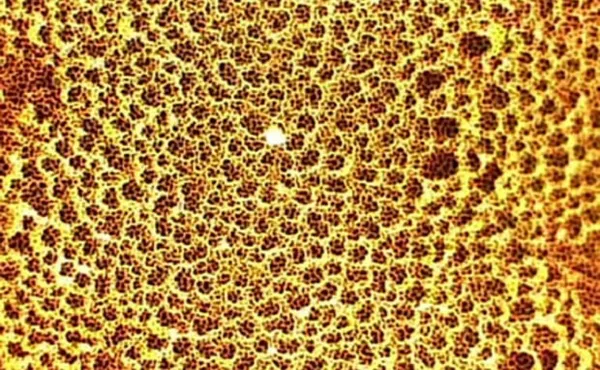
This is made of damage to film, flashes and cell-like structures. There is the suggestion of landscape, but it is as the sensation of spinning in the static of a cathode-ray tube, the implicature of the inner ear, the brain clutching for sense.
James Holcombe's film might not actually be called Grim's Dyke, nor might it be from 2010. It might actually be called Grim's Dyke 2, and be from 2008, no matter what the EIFF programme says. That doesn't change it as a film.
Flickers stop; wrinkles, currents, shards, sprockets, smoke, sediment suggest themselves in the textures before us. The film itself is a thing attacked, artifact upon medium transformed by light into something inexplicable. It might be lines of elevation, a thing melted, and then it is over.
It is sufficiently interesting a spectacle that its oddities are forgiveable, but as with much of 2010's Black Box programme at EIFF it perhaps more rightly belongs in a gallery than a picture-house.
There is a house in Harrow that shares its name with this film, home to WS Gilbert, but this is not quite a short, sharp shock. Nor is it a hotel, nor an outside location for The Avengers or The Saint. It might have more in common with Grim's Ditch, the Anglo-Saxon earth work; it is an intensive effort, affecting landscape, which cannot fully be understood.
Reviewed on: 22 Sep 2010

If you like this, try:
Review preview for Lumphini 2552
Three minutes that are thing and un-thing, a flicker of stillness.
Review preview for Trees Of Syntax, Leaves Of Axis
Dachi Sato's film is striking, the flicker of light through trees like rolling down a forested lane.