



 Facebook
 Reddit
In addition to death and taxes, one other thing, provided you make it that far, is certain - growing old. And while we all like to think of ourselves as vital to the last breath, the reality for many is an inexorable decline as our loved ones look on, powerless to do anything but care. It's a depressing thought, and one that Michael Haneke examines thoughtfully and robustly in his Palme d'Or winner, turning over that horrific consideration almost everyone has from time to time - what happens if and when we become a burden to those we love the most?
We meet Anne (Emmanuelle Riva) at the point where all such concerns have departed, along with life, to another place. Her body is all that is left, lying in bed, surrounded by flowers. Haneke wants us to take a good look at where she, and we, are heading, before going on to spend the film in contemplation of what has been lost.
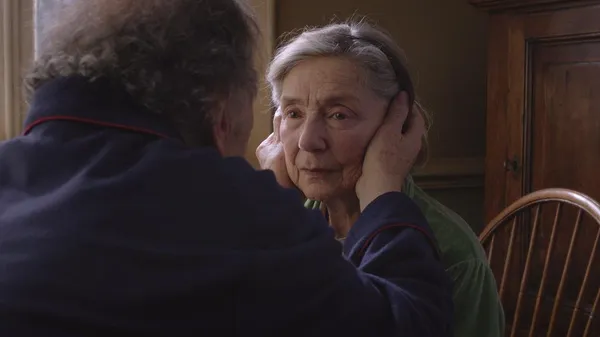
 Anne's was a comfortable, bourgeois lifestyle, complete with beautiful apartment, cultured memories of her career as a piano teacher and a husband whose love and playful sense of humour have stood the test of time. In fact, she and Georges (Jean-Louis Trintignant) are living 24-carat golden years. Age, however, is no respecter of social class and, out of the blue, Anne begins to have 'vacant' episodes. With a diagnosis in, the only way is down and we - as powerless as the couple themselves - watch the slow but steady dimming of Anne's physical and mental light.
Movies about the loss of loved ones - particularly to dementia - have been proliferating lately, from Sarah Polley's festival pleaser Away From Her to mainstream fare such as Friends With Benefits and 50/50. But while that trio of films could be said to err on the 'romantic' side in their portrayal, Haneke's gaze is as sharp as a gimlet. Anne is dying, not without humour and bravery, certainly, but also with the twin bedfellows of pain and despair. If she feels trapped by her illness, what of Georges, desperate to keep a promise not to hospitalise Anne and unable to do anything but push himself to the limits of his physical ability and love as he loses her? While there is a certain predictability to the narrative, Haneke's approach feels fresh and resolutely forthright. He doesn't wallow in Anne's illness but nor does he shy away from it. She and Georges are locked in this together, an isolated island, while friends and family swim around them yet somehow remain out of reach.
Riva and Trintignant are - like so many of the world's older actors - on the top of their game when given a chance to take centre stage. Fear and concern mingle in every facial movement but Haneke keeps us firmly focused on practicalities of caring for the sick, letting the devastatingly emotional impact echo through each scene, without us ever seeing him hammer it home. He goes far beyond pushing emotional buttons into territory where our most visceral fears lurk. Handkerchiefs are required as we watch Anne and Georges move away from the symphony of life to a place where the only music left is the broken sound of Sur Le Pont, d'Avignon, accompanied by the beating of their hearts.
Reviewed on: 08 Oct 2012

Related Articles:
National Board of Review Awards Gala: Part Two San Sebastian Film Festival Diary: Episode 3If you like this, try:
Review preview for Away From Her
Mesmerising, heart-wrenching, and a remarkably intimate vision.
Review preview for Poetry
Veteran actress Yun Jeong-hie, who came out of a 15-year retirement to take on the role of Mija brings a fragile beauty and strength to the part, lending her character an air of inscrutability that is intriguing rather than frustrating.
Review preview for A Simple Life
A Simple Life is a two-hour slice of profound wisdom that gently leads you down to a deep place then whispers helpful truths in your ear.