Sinéad O'Shea on James 'Fergie' Chambers Jr and All About The Money
by Paul Risker
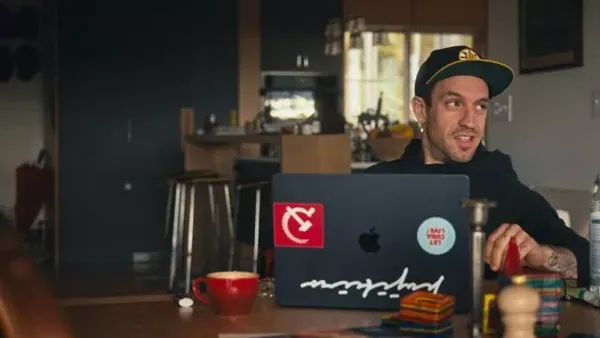
All About The Money Photo: courtesy of the Sundance Institute
At the centre of Irish writer, journalist, and filmmaker Sinéad O'Shea's documentary All About The Money, is James 'Fergie' Chambers Jr, the billionaire heir to the American Cox dynasty who financed a communist collective in Alford, Massachusetts. Envisioning it as a "communist training ground", Fergie provided rent-free houses to individuals and families, amongst them Reggie. After the vandalism of Elbit Systems, the main US supplier of the Israeli military, Fergie fled to Tunisia, a non-extradition country, to avoid arrest. There he funded a local football team and found his life spiralling into dysfunction when disputes within the club arose, and two of his personal relationships ended in quick succession. Currently, he's being held in a Spanish prison while the US Department of Justice seeks his extradition over alleged support of Hamas.
O'Shea made her feature début with the documentary A Mother Brings Her Son To Be Shot, whose title is literal and not a poetic or creative play on words. She has also directed Pray For Our Sinners, which explores the subject of violence against women and children in Ireland, and the biographical documentary Blue Road: The Edna O'Brien Story, which sifts through the Irish writer's collection of journals.
In conversation with Eye For Film, O'Shea discussed finding an intriguing slice of reality to observe and present, expecting more from those champions of progress, sometimes needing to say "fuck you", and being vilified by a Hollywood producer.
The following has been edited for clarity.
Paul Risker: What was the starting point of this journey, and how quickly did you realise what you had in this subject?
Sinéad O'Shea: Pretty much straight away. I met somebody who was living briefly in the commune and, just from the way they described it, this concept of these people all living in beautiful houses, all owned by this really rich man and going to study groups to study Lenin, was a brilliant situation. I sent Fergie a message on Instagram to ask if he would like to participate. He said yes straight away. So, it was quite straightforward.
Fergie's backstory is so compelling because he embodies this type of American dynasty that you don't really have anywhere else. The great-grandfather ran for president, and the maternal grandmother was a programmer for NASA. It's so extraordinary, and they're appearing at all these pivotal points in American history. I knew it was an amazing situation, and I could see how that could be a feature documentary. I mean, maybe there's an argument it could have been a six-part Netflix show, but that would have had a very different sensibility.
I didn't want to be sensational or salacious. And I don't know if I knew, but as the making of it proceeded, I sensed that the events were so singular, that there was no need for me to exaggerate or amp things up in any way.
PR: A part of the film's charm is its messiness, which can feel like we're a pinball ricocheting around because you don't neatly cut from one thing to the next. Rather than holding our hand, we're left to work out how we feel about these characters for ourselves. And throughout, you are trying to sustain a naturalism, even a spontaneity.
SO'S: I think this is appropriate because there's enough handholding in our culture, and it's a handholding/a kind of hypnotising that's happening. And it's so incredibly easy to convince anyone of anything if you're a filmmaker, if you're any good. It's easy to sell an idea, a person or an event and that kind of power is problematic.
I'm not interested in possessing it, but what I can do and what I'm interested in doing is investigating and observing something over a long period of time and then presenting what I've found.
The shoots were straightforward because they were all quite observational. But the editing of this film was lengthy and at times complicated. It was actually difficult to achieve that kind of balance and semblance of spontaneity, and to provide all the nuance in all the information that was unfolding. And as much as possible during the shoot, we were trying to capture what was happening while acknowledging that we were there as an artificial and a potentially disruptive force.
PR: In one scene, Reggie talks about the feelings and ideas that Trump has unleashed. You counter his proposition by pointing out that it's something that must have already been present. It's important to recognise that a lot of the ideological words and actions we are seeing are not new. Rather, it's old ideas being reappropriated by new players.
SO'S: It plays upon a latent sensibility, I suppose, a sense of being left behind and then a group of people who are quite often being manipulated by a smaller but very powerful group. And again, this speaks to why I don't want to be one of the manipulators — I think it's so cheap.
I really like that piece with Reggie. It's powerful, and it was an education for me. I'm not an American; I don't live there, and I don't understand the culture. One of the things about this film is that being an outsider gives you a great perspective and a kind of privilege, because people will try to explain these contexts to you that they may not share on an everyday basis. And that's how the scene with Reggie came about.
PR: So, being the outsider allowed you to get under the skin of your subject in a way that wouldn't have otherwise been possible.
SO'S: Agreed, and I was really glad of it. Again, that's why it's not an authored film, because my second film Pray For Our Sinners was authored, but that was about my hometown. I know that milieu extremely well, and that's me in the mode of Reggie explaining how the system works to the outside world. But here the roles are reversed, and so, I'm asking for edification.
PR: I also think that scene speaks about how we take progress for granted and forget we need to fight for and nurture those hard-won victories. For example, the complacency of the left to allow Roe v. Wade to be overturned.
SO'S: With something like Roe v. Wade, there are some parallels in European, UK, and Irish culture. A lot of these changes are happening because of the complacency of the so-called winning side. It's their refusal, I think, to sometimes engage with people that may not have the same education, may not have the same way about them, but have their own valid needs and concerns. Seeing a larger group become more powerful, wealthier and more complacent causes resentment. So, of course, you want to adopt a whole set of values, which sometimes, I don't even know that everyone believes in. And then, sometimes, you just want to say, "fuck you."
But there is a real onus on people who champion progress to do more, and to be more effective and empathetic.
PR: If there's a fitting word to describe the film, it is probably 'contradictio', because the main subject, Fergie, is a walking contradiction. This lack of clarity, however, can be dangerous in a culture that looks for things to be presented in black and white terms.
SO'S: It makes it impossible to sell and to even get money to make it in the first place, because nobody wants a film that's complex. Everyone wants something that's black or white with a hero or a villain. There's really nobody in the film who is unequivocally heroic or villainous, and that's not good in this market.
PR: Some of what Fergie says is reasonable, thoughtful and empathetic. But then, there's his other side.
SO'S: And that's why it's so frustrating for our sales agents. It would have been a much easier film to sell if I had thrown him under a bus. He absolutely does and says extremely problematic things all the time, but that is not his entire story, and it wouldn't have been truthful.
PR: Early on, I had the impression that Fergie is almost playing a character. You can question whether he knows who he is, and so, the world is a stage to perform. He's dramatic for the sake of being dramatic, which is enabled by his personal wealth.
SO'S: It's a brilliant observation, but then, sometimes, he's really self-aware. I remember he sent me this long message about how he saw himself as Frankenstein's monster, and he was this product of the capitalist system going back generations. I even bought him a copy of Frankenstein, which I included a shot of in the film. But then he asked, "Why did you give me that copy of Frankenstein?" When he read back over the message he'd sent me, he was like, "Oh my God, this is so grandiose." So, yes, it's interesting.
He certainly has enough drama to last him for a long time. The case [against him] is very difficult, and I actually don't think he's guilty of these accusations. I really hope he isn't extradited, but you can see how the case can be built against him — I think it's unfair.
PR: We're in a strange place where a sitting U.S. President who is guilty of rape and has incited an insurrection shows the extent to which there's an inequality of accountability.
SO'S: And this is the underlying anxiety I have when we're continually being told to accept that black is white, which creates the conditions where anything can happen. Any idea or concept can be sold to us.
PR: How do you look back on the experience of making All About the Money?
SO'S: It was compelling throughout and enjoyable in some ways. It was a very gritty shoot, and I was making this at the same time as my previous film, Blue Road: The Edna O'Brien Story, a glossy and lovely film about Edna O'Brien, this amazing Irish writer who's dying. Jessie Buckley does the voiceover and Gabriel Byrne and Barbara Broccoli were executive producers. It was such a wonderful production, whereas this was just me and a cameraman for two years, with no budget, running around America and Tunisia. I guess we were just addicted to this story and what could happen next. And every time I prepared for a trip, I'd ask myself why I was doing this. The Edna film was so consuming, but then, every time I got out there, I'd think, 'this is amazing; this is like the perfect documentary.' And I still think there's something about All About The Money which actually aligns much more with old school and traditional documentary filmmaking, where you're not being sold an idea at all — you're just observing and witnessing these crazy things happenings.
PR: Having seen the film play to an American audience at Sundance earlier this year, and then rolled out to European festivals, most recently London, do you notice differences in the reception?
SO'S: Yes, there's a really big difference. In America, at the opening of the world premiere Q&A, Lawrence Bender, Quentin Tarantino's producer, was shouting for the first five minutes about what a terrible film it was, what a terrible person Fergie is, and how terrible I was for giving him a platform. It was so extreme.
Again, it's this unwillingness to accept what a documentary is. It's not a form of advocacy or opinion journalism — it's not an opinion column. It's documenting a reality that I witnessed.
It's funny because at the 2026 London Film Festival last week, when I introduced the film, I was really preparing the audience for the challenge, so that I wouldn't have to face something like I'd previously experienced in the Q&A afterwards. But actually, I thought the audience were quite unbothered by it. I mean, they were great, and they were well up for the nuance of it.
So, it has played a lot of very big European film festivals. People find it funny, and it is actually a very funny film at times. And they also find it quite moving, and I suppose most people just appreciate the realness of it.
PR: It's a slice of reality.
SO'S: Yes, it is actual reality as opposed to reality television.
PR: Denying reality is more of a problem than confronting it. And again, you're not planting a flag on a hill. Instead, you're just sharing a reality you observed.
SO'S: Definitely not. I would say I'm actually quite pro-Palestine but there are all kinds of ways to support the Palestinian movement. I definitely empathise with how everyone in the film is so frustrated with their present situation and wants to create change. So, I try to speak and stay true to that. But yes, some of the solutions, it's just my job to present them.
All About The Money played at the 2026 London Film Festival and will be released theatrically in Ireland and the UK on 30th October.

 Facebook
 Reddit